
USCIS Signature Requirements: Understanding Valid Signatures, Wet Ink Policies, and How to Avoid Denials
When submitting any application, petition, or request to U.S. Citizenship and Immigration Services (USCIS), the requestor’s signature is crucial. A valid signature confirms that the applicant or petitioner knows, has reviewed, and approves the document’s content, and that they certify its truthfulness under penalty of perjury. If the signature is improper or deficient, USCIS may reject the request and return or reject; similarly, if USCIS accepts a request and later finds the signature deficient, they may deny it or even revoke an approved application or petition.
This article will explain USCIS’s signature requirements, who is authorized to sign, and how to navigate these evolving demands to avoid delays or denials.
What Constitutes a Valid Signature for USCIS?
A valid signature on a USCIS application, petition, or request is a handwritten mark or sign made by a person. This signature serves to confirm that the signatory is aware of the content of the request and all supporting documents, that the person has reviewed and approves all information within the request and accompanying materials and that the person certifies under penalty of perjury that the information in the request and supporting documents is true and correct.
What are Acceptable Signature Formats?
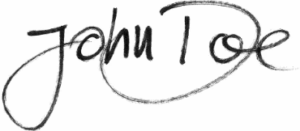
There is no specific signature format as long as it is handwritten signature. Acceptable signature can be a handwritten “X” or similar mark in ink, including a fingerprint if the person is unable to write. It can be an abbreviated signature, as long as it is consistent with how the person normally signs their name. The signatures do not have to be in English or in cursive handwriting.
Example of Valid Signature:
Importantly, a signature is valid even if the original is photocopied, scanned, faxed, or similarly reproduced, as long as the copy is of an original document containing an original handwritten signature, unless specific form instructions state otherwise. USCIS regulations do not explicitly require an “original” or “wet ink” signature on a petition, application, or other request, unless specifically mandated by form instructions.
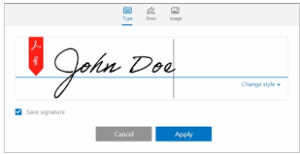
Important Note: electronic signatures are ONLY accepted for benefit requests filed electronically, but only if the requestor follows the instructions for proper electronic signing. Electronic signatures are not accepted for paper filed applications or petitions.
Examples of Unacceptable Signature Formats:
- Typed names on the signature line.
- Signatures created by a typewriter, word processor, stamp, auto-pen, or similar device are generally not accepted. (Note: In some rare instances, a stamped signature may be allowed if explicitly provided by form instructions, such as for a health department physician acting as a blanket-designated civil surgeon).
- Signatures by an attorney or representative signing for the requestor or the requestor’s child.
- A photocopy of a digital signature (e.g., DocuSign) or a signature created with a stamp does not meet the requirements for an acceptable signature; the reproduction must be of an original, wet ink signature.
Example of Invalid Signature:


Who May Sign a USCIS Request?
The signer is responsible for affirming their authority, knowledge of the facts, and the veracity of the claims, and may be held accountable for fraud or misrepresentation. Generally, the person seeking an immigration benefit is the individual who should sign.
Parents (or Legal Guardians)
A parent may sign for a child under 14 years of age. Children 14 or older must sign for themselves. The parent must submit a birth certificate or adoption decree to establish the relationship. When signing for a child under 14 years of age the parent (or legal guardian) should sign the child’s name and then write “By” and sign their name.
A legal guardian may sign for a child under 14 or for a mentally incompetent person of any age. A legal guardian is someone officially designated by a court or public authority with legal authority over the requestor’s affairs. Documentation like official letters of guardianship or court orders are required. When signing the legal guardian should sign the child’s name and then write “By” and sign their name.
Designated Representative or Power of Attorney
For naturalization applications, a designated representative may sign for an applicant who is unable to understand or communicate the Oath of Allegiance due to a physical, developmental disability, or mental impairment. Similarly, USCIS accepts a durable POA for an incapacitated adult. A formal court appointment isn’t always required if the POA grants authority, but it must comply with state laws where it was executed. Evidence, such as a physician’s statement, is usually required to show the POA has taken effect due to the adult’s disability.
Authorized Signers for Corporations or Other Legal Entities
For requests filed by legal entities (e.g., corporations, LLCs), the signer must have the authority to legally bind the entity. Examples include executive officers, managing partners, in-house counsel, or HR employees authorized to sign legal documents. A sole proprietor is the only person authorized to sign for a sole proprietorship. The request must include a statement affirming the signer’s legal authority, the employer’s awareness of the facts, and the truthfulness of the statements. USCIS may request evidence like bylaws or articles of organization to confirm signatory authority.
An attorney (with Form G-28) cannot sign a benefit request or other document on behalf of a person or legal entity.
What Happens if USCIS Finds a Signature Deficient?
A deficient signature has serious consequences and may lead to rejection of a filing, a denial of a request or even a revocation/rescission of an already-approved request. This can have major negative implications. For example, a rejection of a filing may mean that the applicant misses an important filing deadline. A denial of an application also means that the filing fees associated with a request will be lost. And a revocation or rescission of an approved request may leave individual without a benefit such as status.
Recent Issues: “Wet Ink” Signature RFEs and NOIDs
There is an increase in cases where USCIS questions the validity of a signature:

Our observations suggest that this kind of RFE or NOID is likely to be issued if the signature appears to be electronic or typed digitally (for example, typing one’s name using PDF or similar software). When USCIS questions the signature, they would either request a submission of the original ink signature or, more likely, they will request evidence that the individual who signed the request was legally authorized to do so.
Our office has been handling an increasing number of such RFE/NOIDs and we can certainly help with such cases. Feel free to submit a request for evaluation/quote.
Conclusion
Ensuring USCIS filings have valid signatures is paramount to a smooth application process. While USCIS has not yet started requiring original signatures, they have increased their scrutiny to ensure that requests have proper handwritten signature.
We invite you to subscribe to our free weekly immigration newsletter to receive timely updates on this and related topics. We also invite you to contact us if our office can be of any assistance.
About the Author: Dimo Michailov

Related News and Articles
The Capitol Immigration Law Group has been serving the business community for over 15 years and is one of the most widely respected immigration law firms focused solely on U.S. employment-based immigration. Disclaimer: we make all efforts to provide timely and accurate information; however, the information in this article may become outdated or may not be applicable to a specific set of facts. It is not to be construed as legal advice.