

How to Address H-1B RFEs Questioning the 1-Year I-485 Filing Deadline for AC21 Extensions Based on I-140 With a Current Priority Date
H-1B applicants who are submitting H-1B extensions beyond the six-year H-1B limit with a current priority date but who have not filed I-485 adjustment of status may face increased scrutiny by USCIS regarding their H-1B eligibility. While USCIS regulations generally require an adjustment of status application to be filed within one year of a visa becoming available, there are a number of legitimate reasons why an H-1B worker may not have filed their I-485 yet.
Background on H-1B Extensions Beyond the Sixth-Year Limit
The maximum period of authorized admission for an H-1B worker is six years. This six-year period includes any time the worker spent in L-1 (intracompany transferee). Once this limit is reached, a foreign national must typically remain outside the United States for one continuous year to be eligible for a new six-year period.
However, the American Competitiveness in the Twenty-First Century Act (AC21) provides several exemptions allowing H-1B workers to extend their stay beyond the six-year limit. The most common exemptions are:
-
Per-Country Limitation Exemption (AC21 § 104(c)): Under 8 CFR § 214.2(h)(13)(iii)(E), an H-1B nonimmigrant may be eligible for extensions in up to three-year increments if they are the beneficiary of an approved I-140 petition but are ineligible to adjust status due to per-country visa availability limitations (or if their priority date is not “current”).
-
Lengthy Adjudication Delay Exemption (AC21 § 106(a)): Under 8 CFR § 214.2(h)(13)(iii)(D), an H-1B nonimmigrant may obtain extensions in one-year increments if at least 365 days have elapsed since the filing of a permanent labor certification with the Department of Labor, or since the filing of an I-140 immigrant visa petition with USCIS.
The 1-Year I-485 Filing Requirement for AC21 § 106(a) Extensions
While AC21 § 106(a) provides a lifeline for workers facing lengthy green card processing delays, it comes with a strict caveat. Under 8 CFR § 214.2(h)(13)(iii)(D)(10), USCIS may not approve a one-year extension based on a lengthy adjudication delay if the beneficiary does not file an adjustment of status application (Form I-485) or apply for an immigrant visa within one year of an immigrant visa becoming available.
An immigrant visa is considered authorized for issuance based on the beneficiary’s preference category and country of chargeability as published in the Department of State Visa Bulletin. When the priority date becomes current, the one-year clock begins to tick.
Specific Issues Raised in H-1B Petition RFEs
USCIS may issue RFEs challenging the one-year extension by pointing out that a visa was available, but no I-485 was filed. For example, an RFE may explicitly note that an employment-based immigrant visa had been available to the beneficiary for the previous 3 years. The RFE then asserts that the petitioner failed to provide evidence that the beneficiary filed an application to adjust status within one year of that availability date.
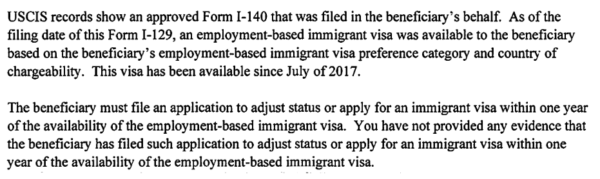
When addressing an RFE that questions this deadline, it is critical to emphasize that there are multiple valid reasons why a beneficiary with a current priority date has not yet filed Form I-485. The two most common defenses involve legal impossibility due to a change in employment and the interruption of the one-year window due to visa retrogression.
Reason 1: Change of Employer and Circumstances Beyond the Beneficiary’s Control
A frequent reason a beneficiary has not filed an I-485, despite a current priority date, is a change in employment. USCIS regulations explicitly state that the agency may excuse a failure to file an Adjustment of Status application “if the alien establishes that the failure to apply was due to circumstances beyond his or her control”.
If the approved I-140 was sponsored by a previous employer, and the beneficiary has since changed jobs, it is legally impossible to file Form I-485 based on that old employer’s job offer. This separation from the original I-140 sponsor constitutes an absolute circumstance beyond the beneficiary’s control, which fully excuses the failure to file under 8 CFR § 214.2(h)(13)(iii)(D)(10).
To further demonstrate good faith in these scenarios, the current employer can provide evidence that a new green card process has been initiated, such as submitting a recently filed Prevailing Wage Request, ongoing PERM Labor Certification recruitment, or a filed and pending PERM Labor Certification.
Reason 2: Interruption of the 1-Year Period Due to Visa Retrogression
Another common reason an I-485 is not filed within the initial one-year window is that the visa availability was interrupted by retrogression. RFEs often incorrectly claim that a visa has been continuously available since a specific date in the past.
The regulations provide a strict “reset” provision: if the accrual of the one-year period is interrupted by the unavailability of an immigrant visa, a new one-year period is given when an immigrant visa again becomes immediately available. By examining historical Department of State Visa Bulletins, petitioners can often prove that a category experienced retrogression, completely interrupting the 1-year clock. If the visa became unavailable during the timeline in question, any 1-year clock that may have accrued is legally interrupted and reset under 8 CFR § 214.2(h)(13)(iii)(D)(10).
Attorney Assistance with Preparing an RFE Response
Our office has focused on H-1B petitions for many years and, having handled many such RFEs, we feel that we have been able to understand the facts and documents USCIS adjudicators expect to see in order to issue an approval. Our office will be happy to provide consultations or assistance with responding to this (or other) kind of RFEs. If you would like to schedule a consultation with an attorney to discuss a specific case (but perhaps without engaging us to help with the RFE filing), we offer phone consultations. We are also happy and available to assist with a more comprehensive RFE response representation. Please feel free to complete this RFE inquiry form and we will be happy to provide thoughts and, if applicable, a quote for our legal assistance.
About the Author: Dimo Michailov

Related News and Articles
The Capitol Immigration Law Group has been serving the business community for over 15 years and is one of the most widely respected immigration law firms focused solely on U.S. employment-based immigration. Disclaimer: we make all efforts to provide timely and accurate information; however, the information in this article may become outdated or may not be applicable to a specific set of facts. It is not to be construed as legal advice.